Table of Contents
- Introduction
- What Is Soil Testing and Why It Matters
- Role of Geotechnical Investigation in Industrial Construction
- Key Soil Testing Parameters for Industrial Sites
- Benefits of Soil Testing for Industrial Construction & Expansion
- Critical Risks of Skipping Soil Testing
- Types of Soil Tests Conducted in Industrial Projects
- Soil Testing Requirements for Heavy Machinery & Foundations
- Environmental & Contamination Assessment
- Cost of Geotechnical Surveys: What Industries Should Expect
- Conclusion
1.Introduction
Before beginning any industrial construction or planning for industrial expansion, the most critical step that determines the success and safety of the project is soil testing. As facilities grow more complex and industries demand stronger, more efficient infrastructure, understanding the soil’s behavior becomes essential.
At Lotus Enviro Systems Private Limited, we specialize in comprehensive geotechnical investigations, site assessments, and subsurface exploration to ensure that every industrial project stands on a foundation of reliability, safety, and long-term performance.
2.What Is Soil Testing and Why It Matters?
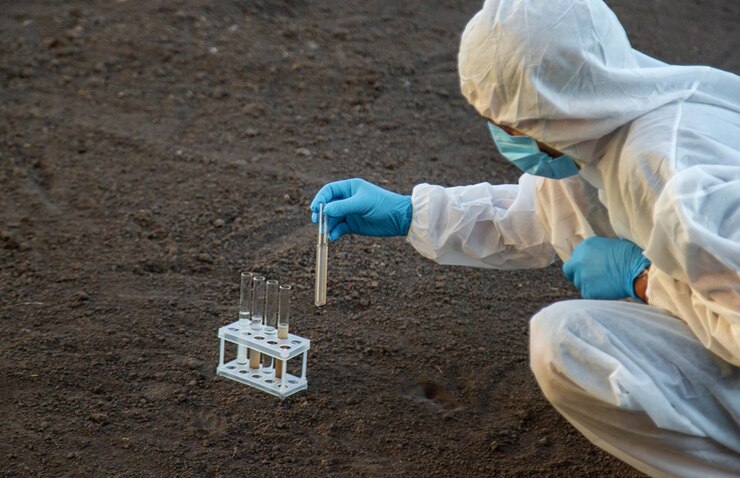
Soil testing is a scientific evaluation of the physical, chemical, and engineering properties of soil at a proposed construction site. Industrial structures carry high loads, operate heavy machinery, and require stable foundations—making soil testing essential.
Why is soil testing important for industrial sites?
Because it reveals crucial details like bearing capacity, shear strength, settlement prediction, and environmental risks. These insights guide engineers in planning safe and sustainable structures.
3.Role of Geotechnical Investigation in Industrial Construction
A geotechnical investigation evaluates subsurface conditions through techniques like borehole drilling, sampling, and in-situ testing. This investigation provides essential data for:
- Foundation engineering
- Construction planning
- Structural integrity
- Soil stabilization techniques in construction
- Risk identification and mitigation
Without these insights, industrial construction becomes vulnerable to failures, delays, and excessive costs.
4.Key Soil Testing Parameters for Industrial Sites
During a site assessment, engineers focus on parameters that influence the long-term safety of the structure:
- Compaction testing
- Soil resistivity
- Shear strength
- Moisture content
- Settlement prediction
- Bearing capacity
- Contamination levels
- Density & permeability
Each factor helps engineers design foundations that can withstand heavy industrial loads.
5.Benefits of Soil Testing for Industrial Construction & Expansion
✓ Accurate Construction Planning
Soil analysis provides essential data for structural design, helping prevent construction delays and unnecessary costs.
✓ Ensures Structural Integrity
Testing ensures that foundations can safely support industrial structures, heavy equipment, and dynamic loads.
✓ Improved Risk Mitigation
Identifies potential issues such as soil instability, groundwater challenges, or contamination risks before construction begins.
✓ Helps Avoid Construction Failure
Most cases of construction failure—foundation cracks, tilting, subsidence—can be traced back to inadequate soil testing.
✓ Mandatory for Industrial Expansion
When expanding an existing facility, soil testing ensures new structures are compatible with the original ground conditions.
6.Critical Risks of Skipping Soil Testing
Not conducting soil testing can result in:
- Structural damage or collapse
- Increased construction costs
- Heavy machinery instability
- Delays due to unsafe ground conditions
- Long-term maintenance and repair issues
- Environmental compliance violations
Industrial sites, due to their high load and operations, cannot afford such risks.
7.Types of Soil Tests Conducted in Industrial Projects
Lotus Enviro Systems offers a comprehensive range of soil testing services:
- Laboratory Tests
- Moisture content
- Grain size distribution
- Atterberg limits
- Compaction testing
- Shear strength test
- Field Tests
- Standard Penetration Test (SPT)
- Plate load test
- Cone Penetration Test (CPT)
- In-situ density tests
- Borehole logging and sampling
- Chemical Analysis
- Soil resistivity
- Contamination assessment
- pH & organic content
These tests collectively determine the suitability of the site for industrial development.
8.Soil Testing Requirements for Heavy Machinery & Foundations
Industrial facilities rely on equipment such as boilers, turbines, compressors, and storage tanks. Soil testing for heavy machinery foundations ensures:
- Vibration control
- Settlement prevention
- Load-bearing capacity
- Long-term operational safety
Without proper foundation engineering, heavy machinery can cause structural instability or vibrations affecting nearby operations.
9.Environmental & Contamination Assessment
For industrial construction, understanding environmental conditions is equally important. Our experts evaluate:
- Soil contamination levels
- Impact on groundwater
- Suitability for industrial expansion
- Remediation requirements
This ensures compliance with environmental regulations and prevents future liabilities.
10.Cost of Geotechnical Surveys: What Industries Should Expect
The cost of geotechnical survey for industrial projects depends on:
- Site size
- Depth of investigation
- Number of boreholes
- Type of soil tests
- Presence of contamination
While costs vary, soil testing is a small investment compared to the potential loss from structural failure or compliance issues.
11.Conclusion
Soil testing is not merely a technical requirement—it is the foundation of successful industrial construction and industrial expansion. From choosing the right foundation design to ensuring structural integrity and preventing construction failures, soil testing plays a critical role in project safety and sustainability.
At Lotus Enviro Systems Private Limited, we provide end-to-end soil testing, geotechnical investigation, site assessment, and environmental evaluation services to ensure your industrial project is built on a solid, dependable foundation.